Climate for Station: Kjusjur, Sakha (Yakutia) Republic, Russia
Loading live weather...
Climate Analysis & Overview
The climate profile of Kjusjur, located in the remote reaches of the Sakha Republic, reveals a warming trend over both short and long-term periods. Notably, the temperature lows are rising significantly, indicating a warming influence on this cold region. Precipitation patterns have become slightly more evenly distributed, reflecting subtle shifts in local weather dynamics.
Arctic Temperature Dynamics
Kjusjur, situated at 70.68°N, 127.4°E, experiences a subarctic climate, classified as Dfc under the Köppen system. This classification is characterised by long, extremely cold winters and short, mild summers. The region's geography, marked by its proximity to the Arctic Ocean and expansive tundra, significantly influences its climate patterns. Over the past decade, the area has witnessed a notable warming trend with temperature lows increasing by 0.98°C (1.76°F). This is a stark contrast to the all-time trend where lows have risen by 0.14°C (0.25°F), indicating a consistent warming pattern. The highs have also increased, albeit more modestly, with a 0.10°C (0.18°F) rise over the last decade, compared to an all-time increase of 0.16°C (0.29°F).
Extreme Temperature Records
Kjusjur's climate is marked by extreme temperatures, with record highs and lows that underscore its harsh environment. The highest recorded temperature is 34.3°C (93.7°F), while the lowest plummets to a chilling -61.6°C (-78.9°F). These extremes highlight the significant thermal oscillations characteristic of the region, influenced by its latitude and the absence of moderating geographical features such as large bodies of water or mountain ranges.
Precipitation Patterns and PCI Insights
The Precipitation Concentration Index (PCI) for Kjusjur has shown a slight decrease from a baseline of 14.67 to a current value of 13.06. This indicates that precipitation is becoming more evenly distributed throughout the year, a subtle yet noteworthy shift in the region's hydrological cycle. A PCI under 10 would suggest very even distribution, so Kjusjur remains on the more concentrated side, but the trend towards more even distribution could influence local ecosystems and water resource management.
Implications of Warming Trends
The warming trends observed in Kjusjur align with broader climatic changes across the Arctic region, where warming is occurring at approximately twice the global average rate. This has significant implications for Russia's climate goals, particularly in terms of managing permafrost degradation and its impacts on infrastructure and ecosystems. The increase in temperature lows, in particular, suggests a shift in the baseline climate that could alter the region's ecological balance and human activities.
Station Statistics
10-Year Trend
High: +0.13 °C/decade
Low: +1.14 °C/decade
Rain: +0.05 mm/decade
25-Year Trend
High: +0.73 °C/decade
Low: +0.87 °C/decade
Rain: -0.05 mm/decade
50-Year Trend
High: +0.47 °C/decade
Low: +0.45 °C/decade
Rain: -0.00 mm/decade
All-Time Trend
High: +0.01 °C/decade
Low: +0.01 °C/decade
Rain: +0.04 mm/decade
Percentage Above-Average Days
Last 12 Months: 56.4%
This Year: 33.1%
Precipitation Concentration Index (PCI) ℹ️
Last 12 Months: 16.1
Historical Average: 13.0
Percentile Rank of Last 12 Months ℹ️
High: 48th percentile
Low: 55th percentile
Rain: 57th percentile
Change in Variance ℹ️
High: -3.1%
Low: -6.0%
Intraday: +22.3%
Data Coverage
89.0%
First Year of Data
1913
Station Location
Historical Weather Records
| Max High | Avg High | Min High | Max Avg | Avg Avg | Min Avg | Max Low | Avg Low | Min Low | Max Precipitation | Avg Precipitation | Max Snow | Avg Snow | |
|---|---|---|---|---|---|---|---|---|---|---|---|---|---|
| Record | 34.3 °C | — | -57.3 °C | 27.2 °C | — | -58.2 °C | 21.2 °C | — | -61.6 °C | 42.3 mm | — | — | — |
| January | -6.8 °C | -34.0 °C | -57.0 °C | -9.9 °C | -37.5 °C | -57.5 °C | -12.4 °C | -41.4 °C | -60.0 °C | 7.0 mm | 0.4 mm | — | — |
| February | -6.4 °C | -31.1 °C | -57.3 °C | -9.6 °C | -34.6 °C | -58.2 °C | -11.1 °C | -38.7 °C | -59.4 °C | 8.4 mm | 0.4 mm | — | — |
| March | 2.1 °C | -20.9 °C | -45.3 °C | -0.2 °C | -25.9 °C | -47.9 °C | -4.2 °C | -31.1 °C | -51.8 °C | 8.0 mm | 0.4 mm | — | — |
| April | 9.2 °C | -9.4 °C | -35.0 °C | 4.4 °C | -14.8 °C | -39.2 °C | 1.8 °C | -20.5 °C | -47.2 °C | 11.5 mm | 0.4 mm | — | — |
| May | 26.0 °C | 1.1 °C | -16.7 °C | 17.0 °C | -2.9 °C | -20.7 °C | 10.6 °C | -7.2 °C | -30.9 °C | 24.9 mm | 0.6 mm | — | — |
| June | 32.3 °C | 13.3 °C | -3.0 °C | 25.8 °C | 8.5 °C | -5.6 °C | 19.4 °C | 4.2 °C | -13.1 °C | 23.7 mm | 1.1 mm | — | — |
| July | 34.3 °C | 17.7 °C | 3.5 °C | 27.2 °C | 12.7 °C | 2.0 °C | 21.2 °C | 8.0 °C | -2.2 °C | 40.7 mm | 1.6 mm | — | — |
| August | 31.0 °C | 14.2 °C | 0.1 °C | 24.6 °C | 9.8 °C | -1.1 °C | 19.7 °C | 5.5 °C | -5.4 °C | 42.3 mm | 1.7 mm | — | — |
| September | 22.1 °C | 5.6 °C | -12.0 °C | 14.9 °C | 2.2 °C | -16.1 °C | 10.9 °C | -1.1 °C | -20.2 °C | 32.7 mm | 1.4 mm | — | — |
| October | 8.8 °C | -8.3 °C | -35.0 °C | 5.9 °C | -11.2 °C | -37.6 °C | 3.4 °C | -14.7 °C | -41.2 °C | 19.3 mm | 1.1 mm | — | — |
| November | -1.0 °C | -24.8 °C | -49.3 °C | -3.6 °C | -28.6 °C | -50.7 °C | -5.5 °C | -32.6 °C | -52.1 °C | 10.7 mm | 0.6 mm | — | — |
| December | -4.4 °C | -31.2 °C | -56.0 °C | -9.2 °C | -34.9 °C | -57.9 °C | -13.1 °C | -38.9 °C | -61.6 °C | 10.4 mm | 0.5 mm | — | — |
Data Visualisations
Remove WatermarksCurrent Year Climate Trends vs Historical
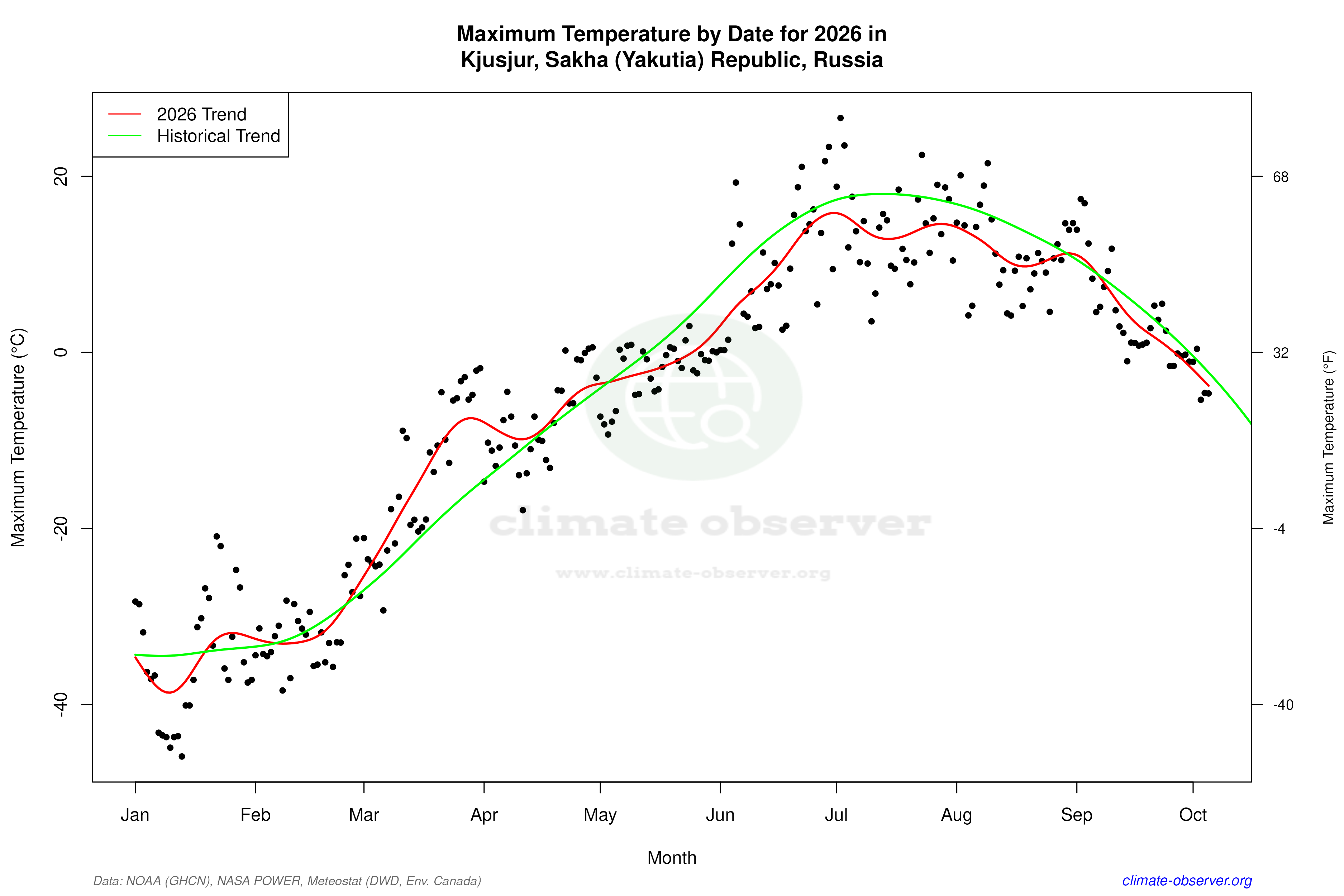
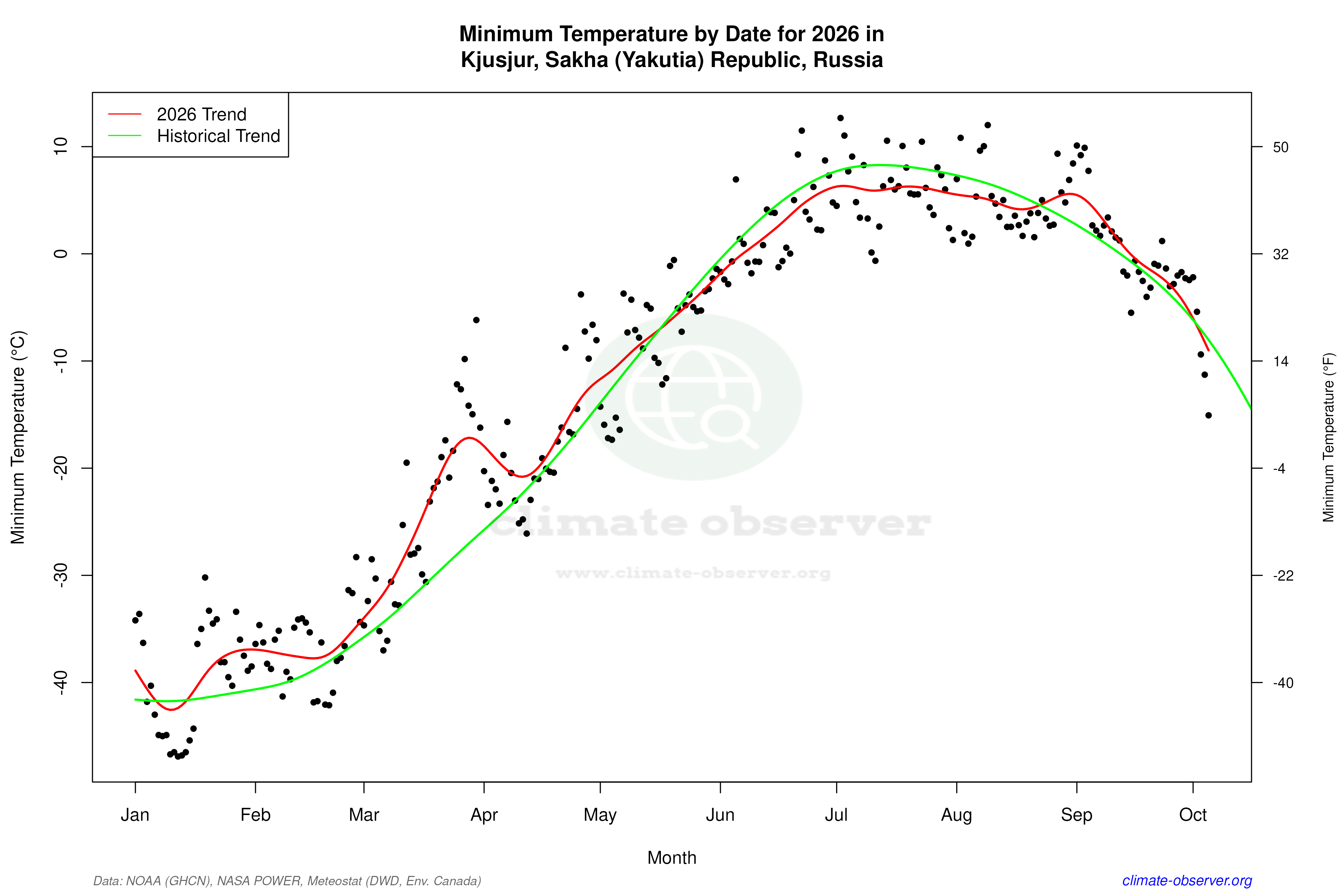
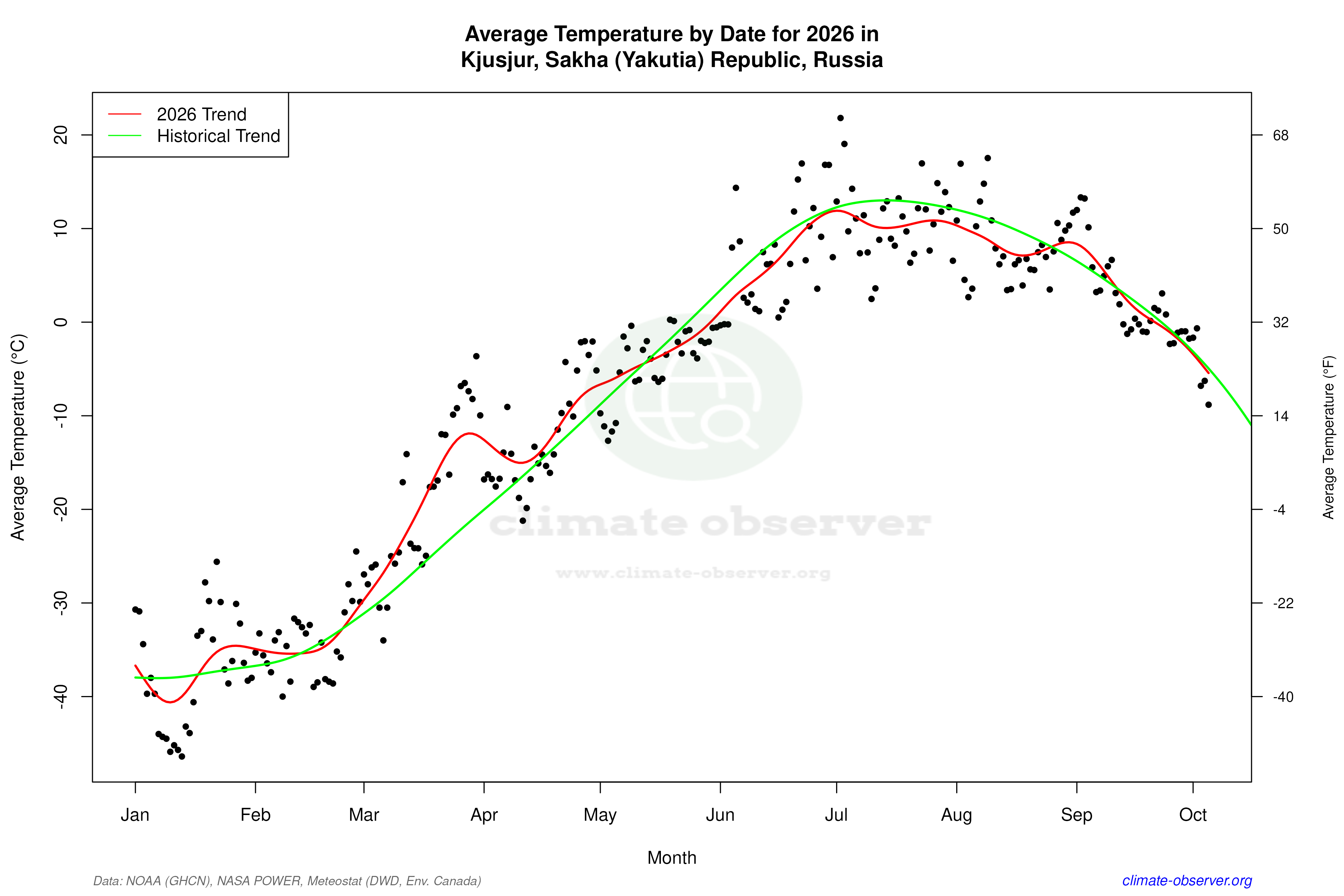
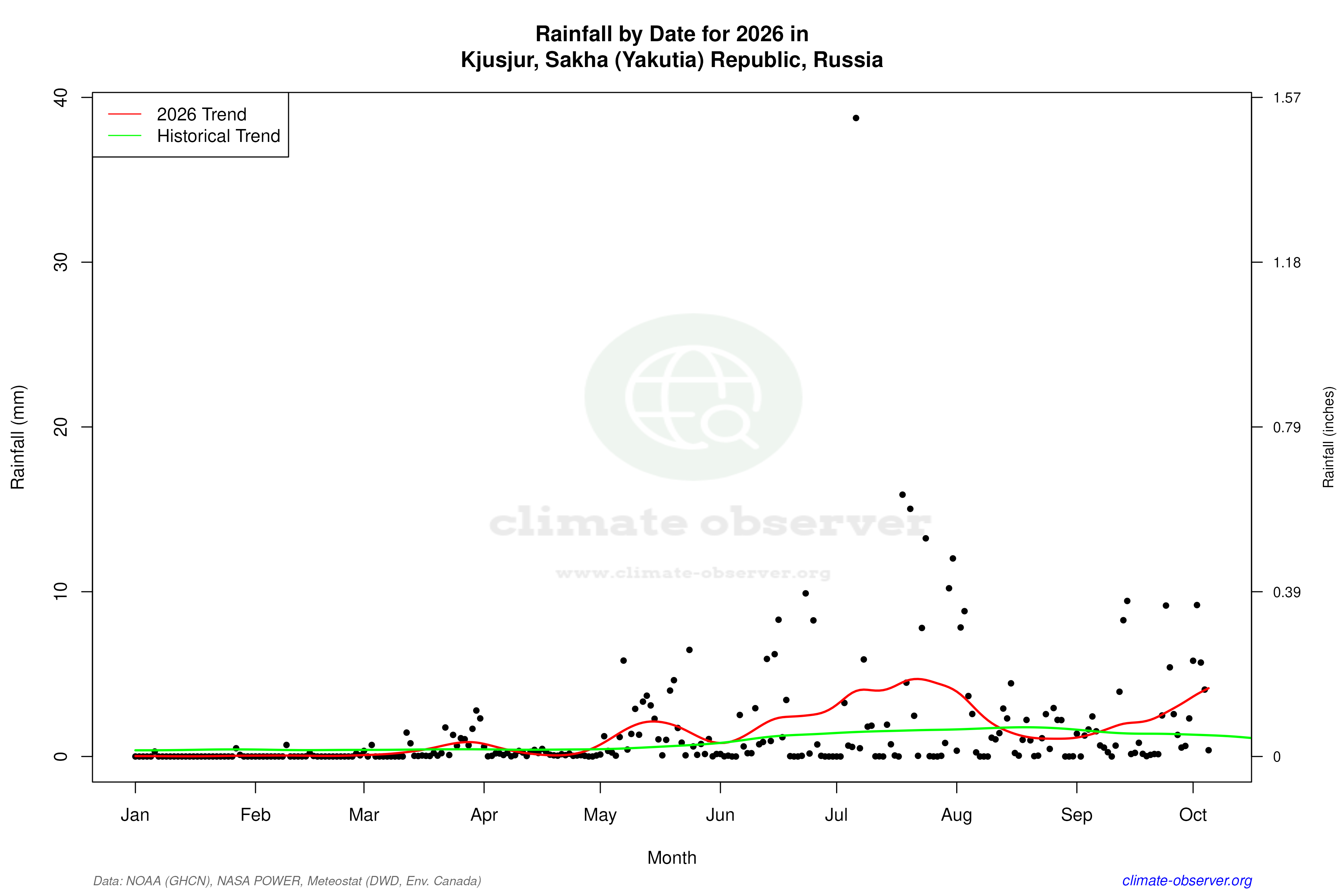
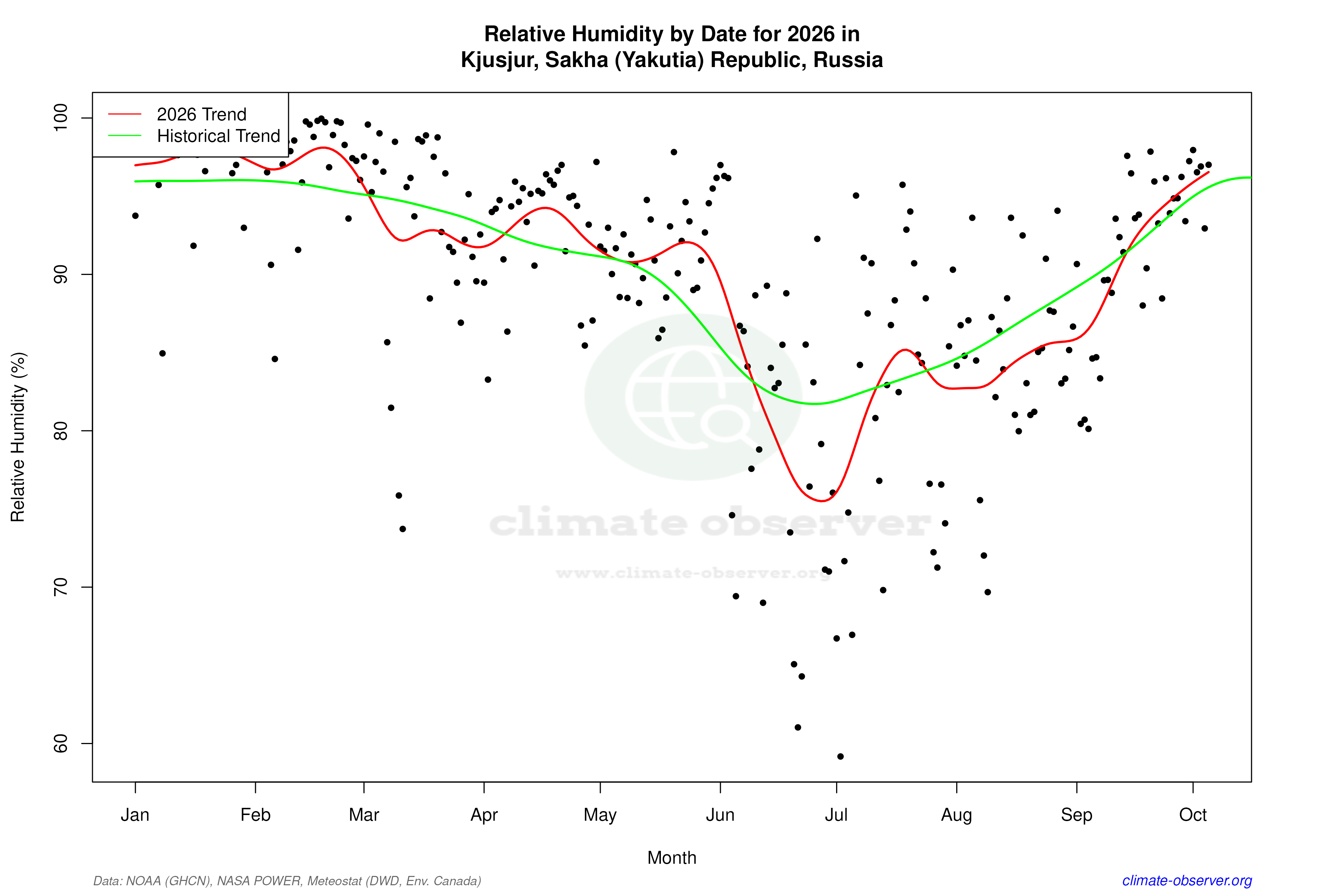

Max Temperature this Year | 1 of 6
Climate 12-Month Moving Averages
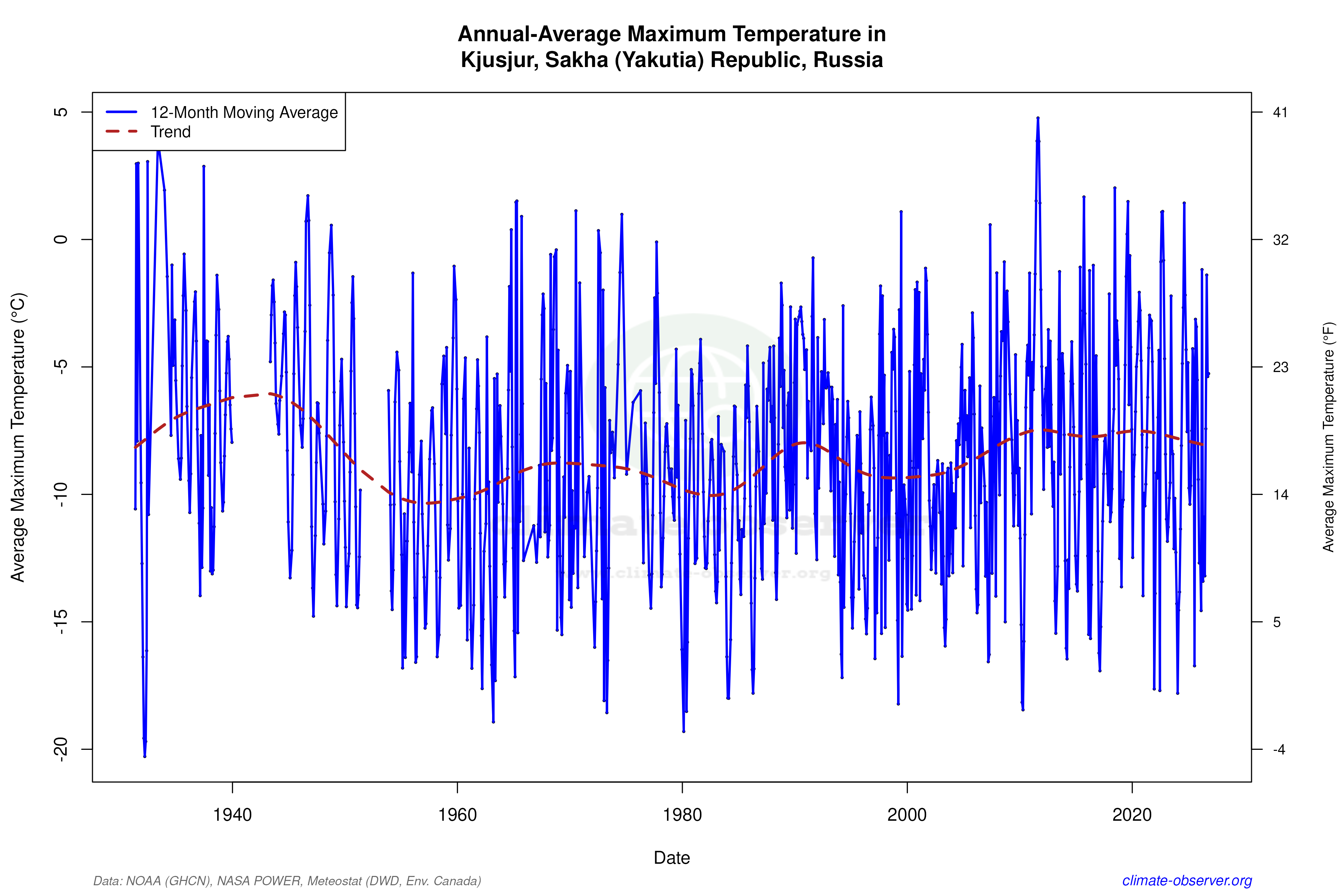
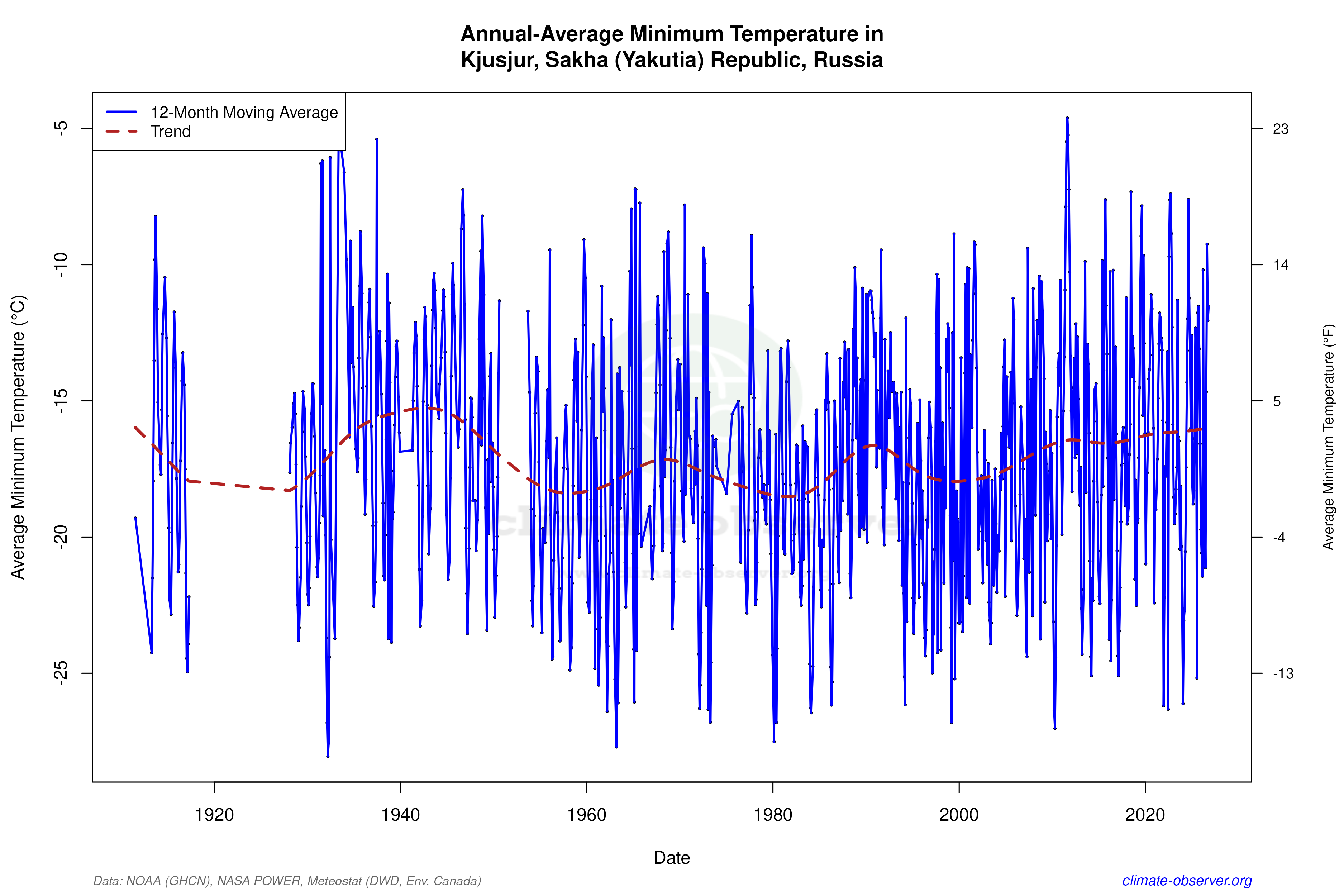
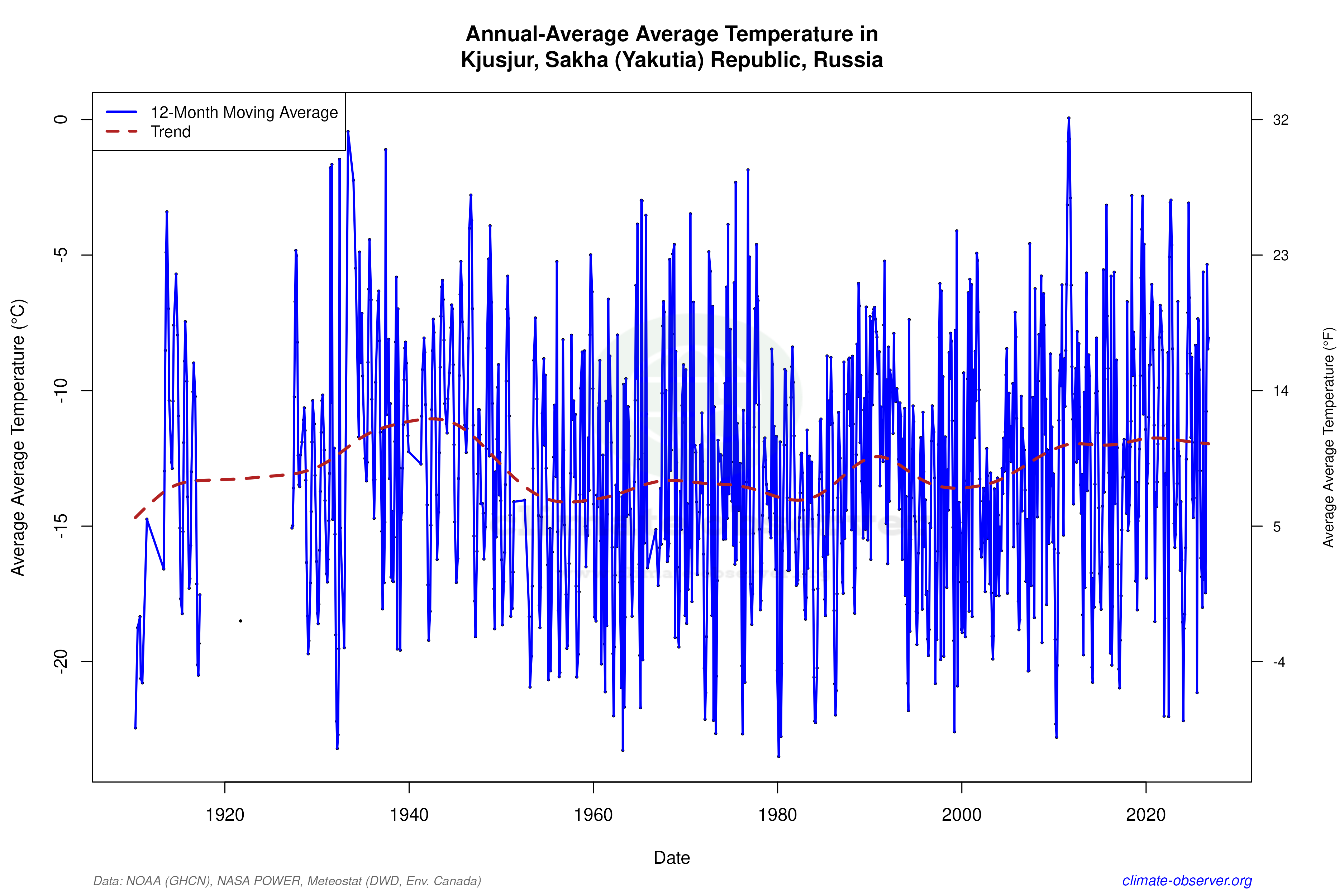
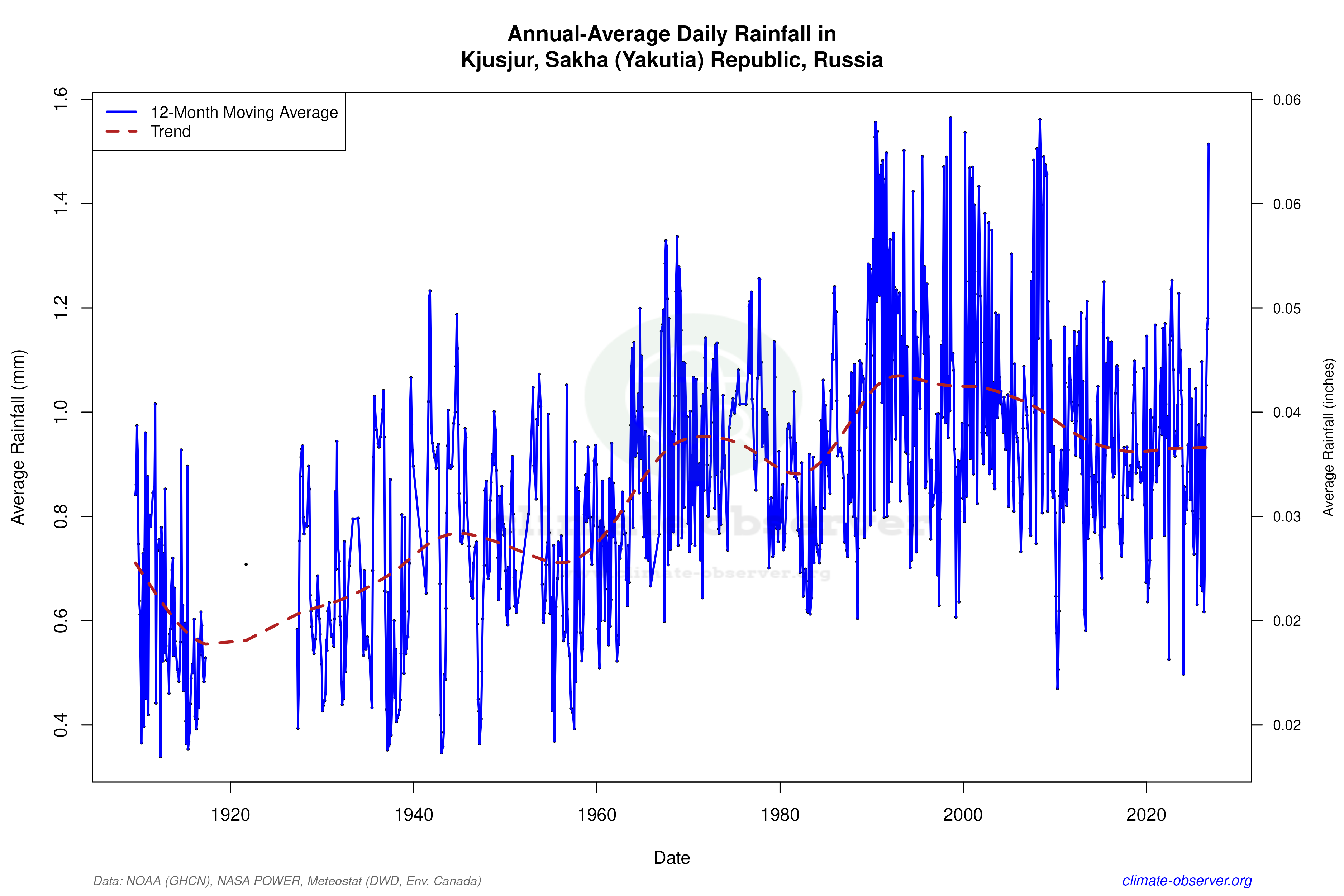
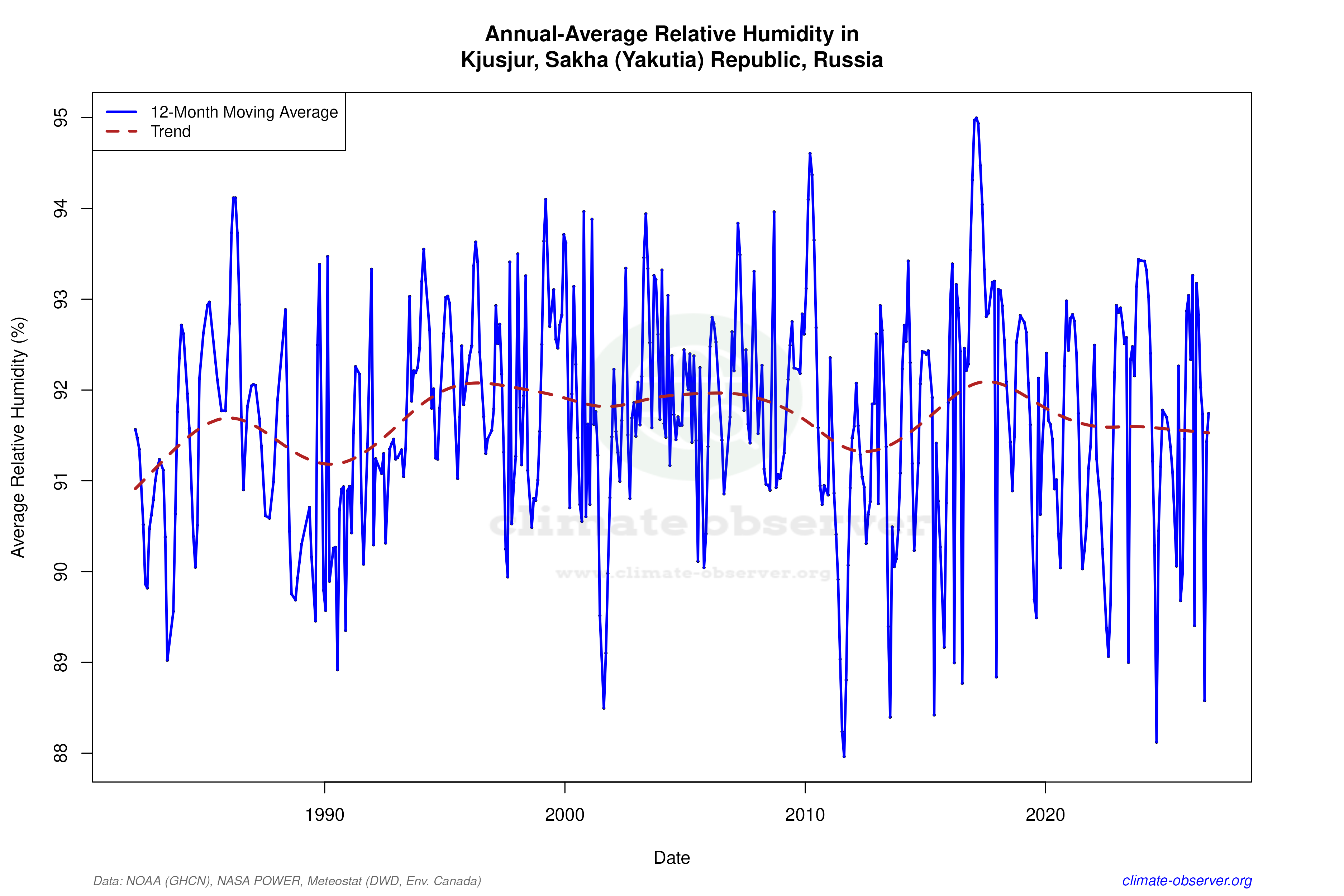

Max Temperature 12-Month MA | 1 of 6
Daily Data Points and Averages Throughout the Year
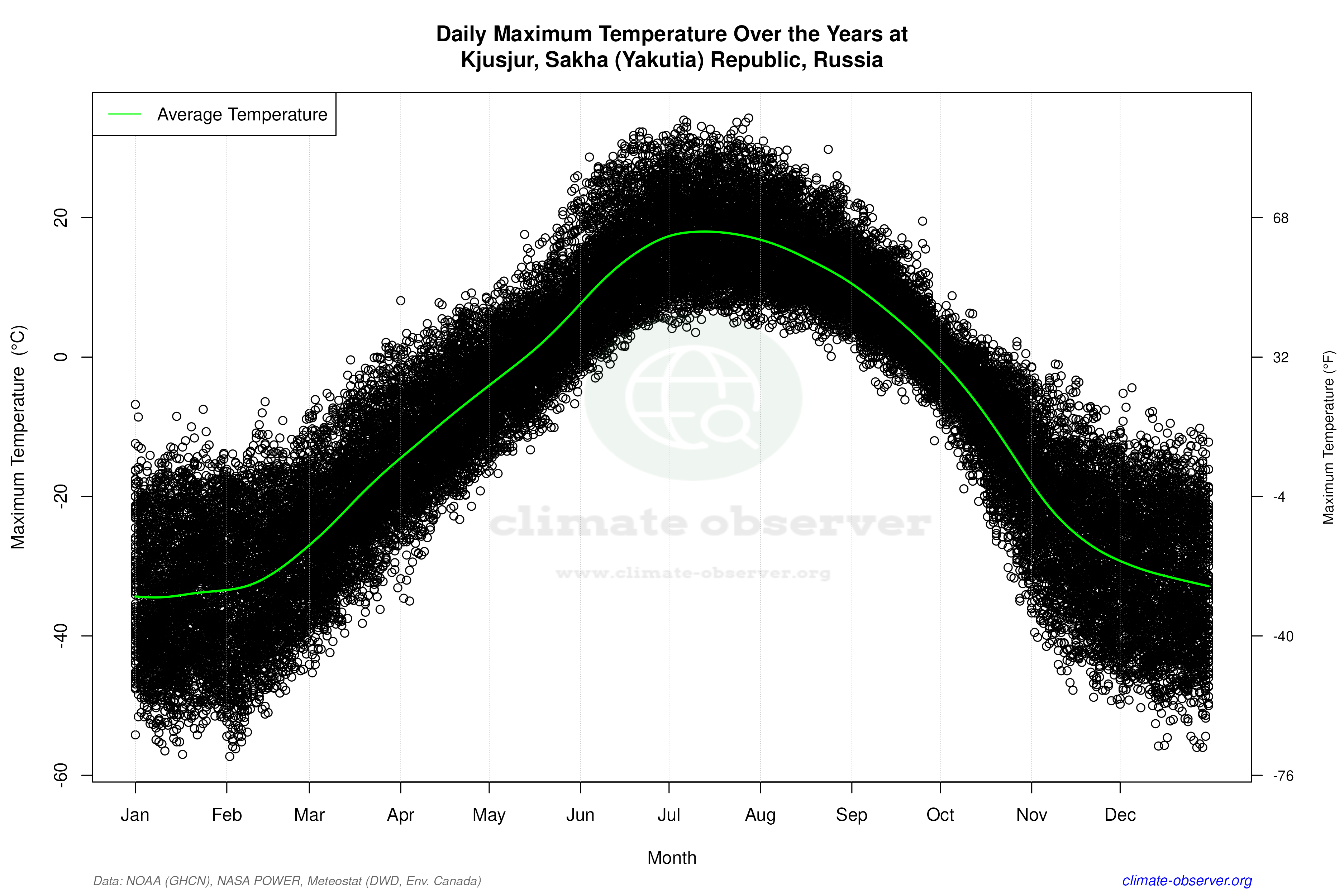
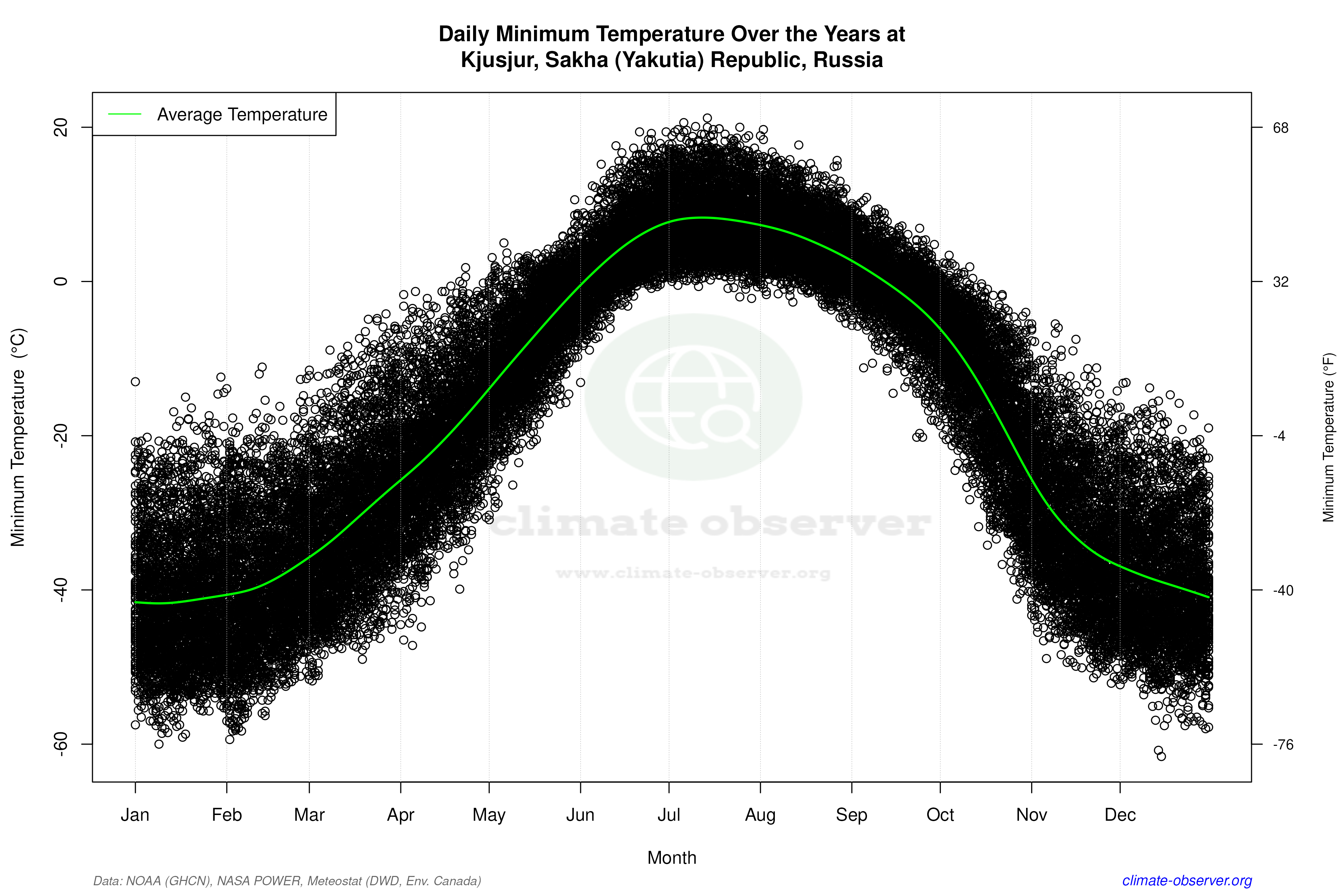
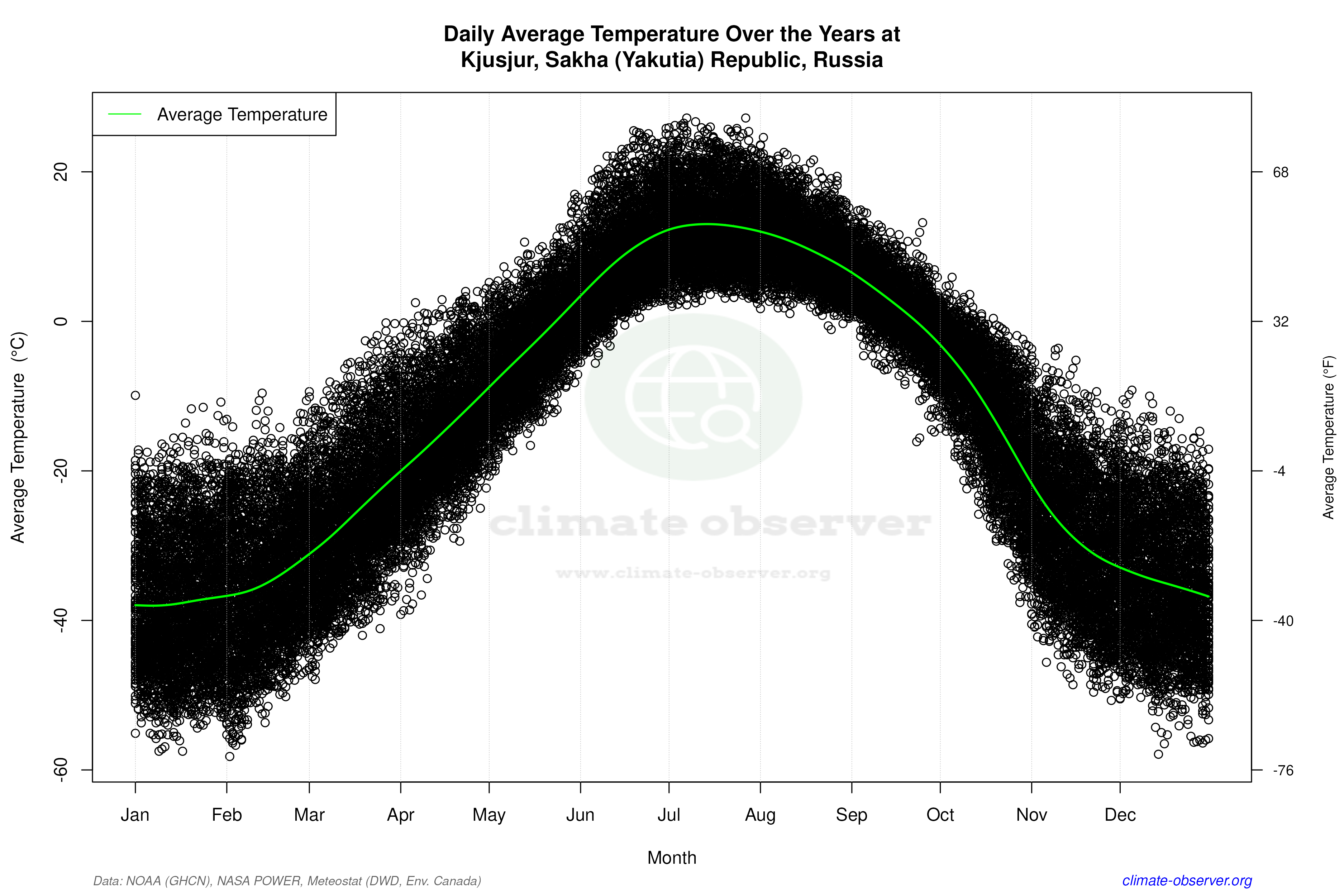
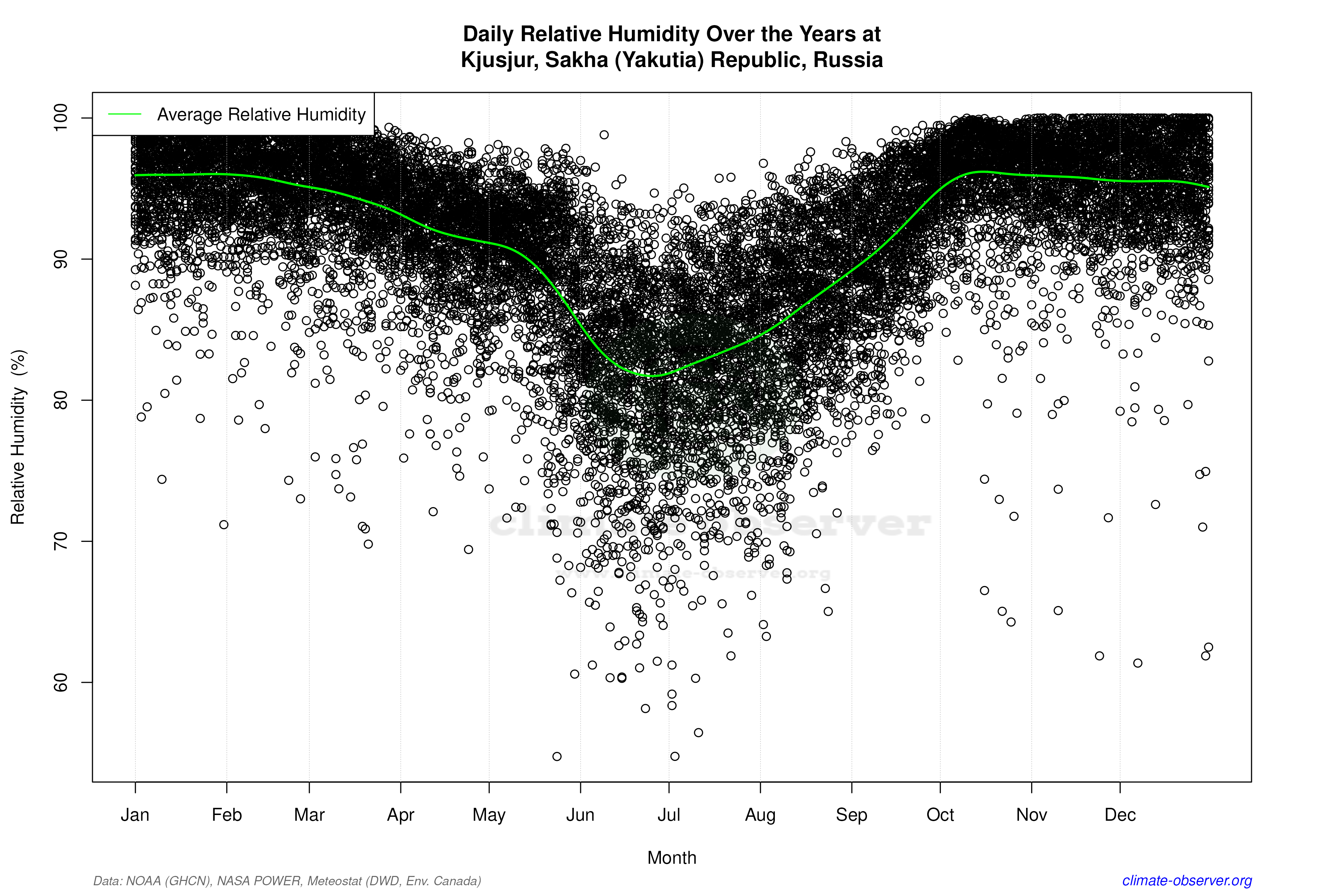

Average Max Temperature Throughout Year | 1 of 5


