Climate for Station: Boulder, Montana, United States
Loading live weather...
Climate Analysis & Overview
Boulder, Montana, is experiencing a nuanced climate shift, with a 1.35°C (2.43°F) rise in high temperatures over the past decade, contrasting with a slight all-time warming trend. The area's precipitation is becoming increasingly concentrated, indicating more intense rainfall events.
Mountainous Climate Dynamics
Boulder, located in Jefferson County, Montana, is characterised by a Köppen climate classification of Dfb, indicating a humid continental climate with warm summers and cold, snowy winters. Nestled in the Rocky Mountains, the region's climate is heavily influenced by its elevation and topography, which contribute to significant temperature variations and precipitation patterns. This geographical context is essential for understanding the local climate data and trends.
Temperature Trends: A Tale of Two Scales
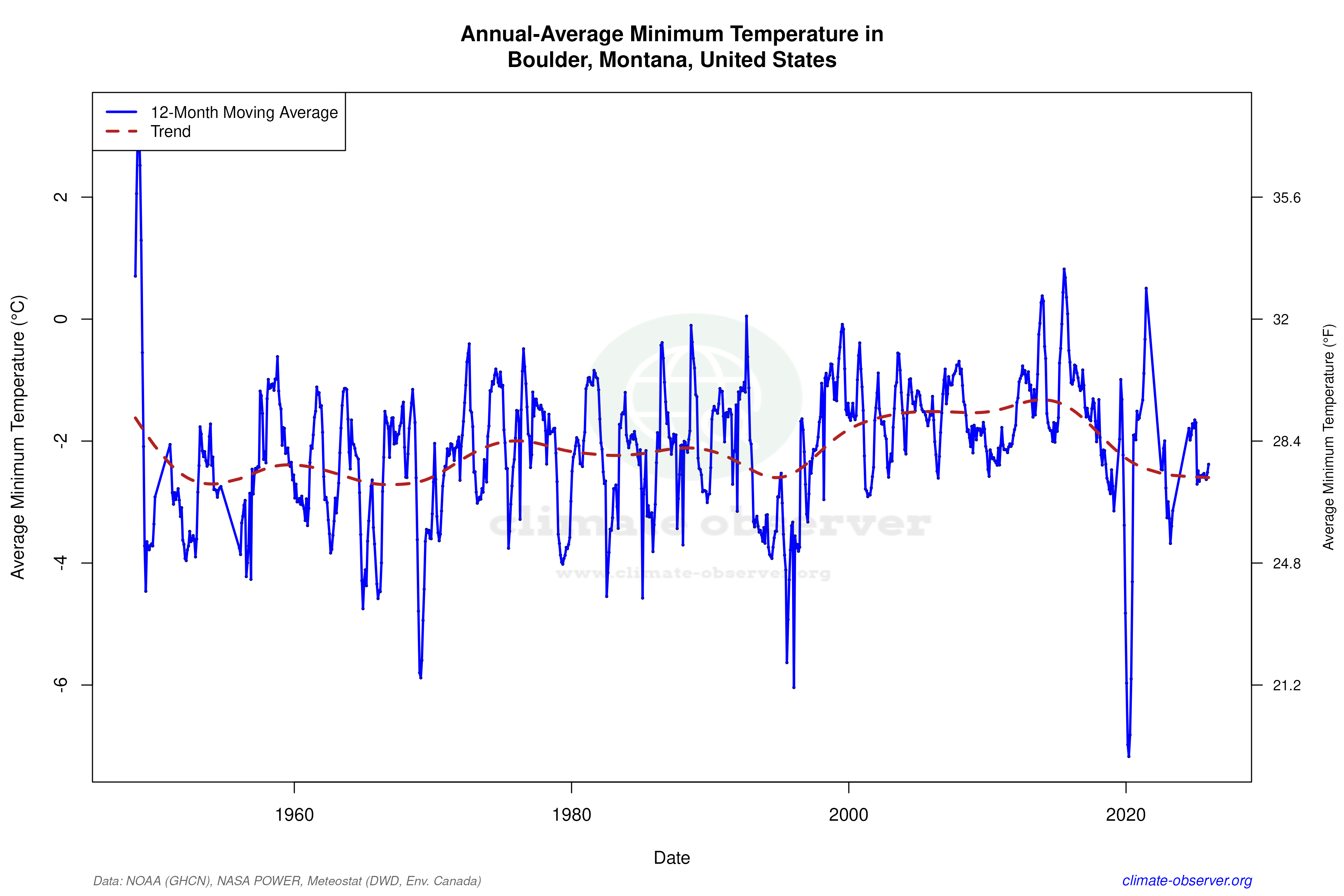
In examining Boulder's temperature trends, a dichotomy emerges between short-term and long-term data. Over the past decade, high temperatures have risen by 1.35°C (2.43°F), suggesting a notable warming trend. However, the all-time data reveals a much subtler increase, with highs rising by only 0.15°C (0.27°F). Conversely, the low temperatures tell a different story: a decline of 0.86°C (1.55°F) over the past ten years, juxtaposed with a marginal all-time rise of 0.14°C (0.25°F). This indicates that while recent years have seen more pronounced warming in daytime temperatures, the long-term trend is more stable.
Precipitation Patterns: Intensifying Events
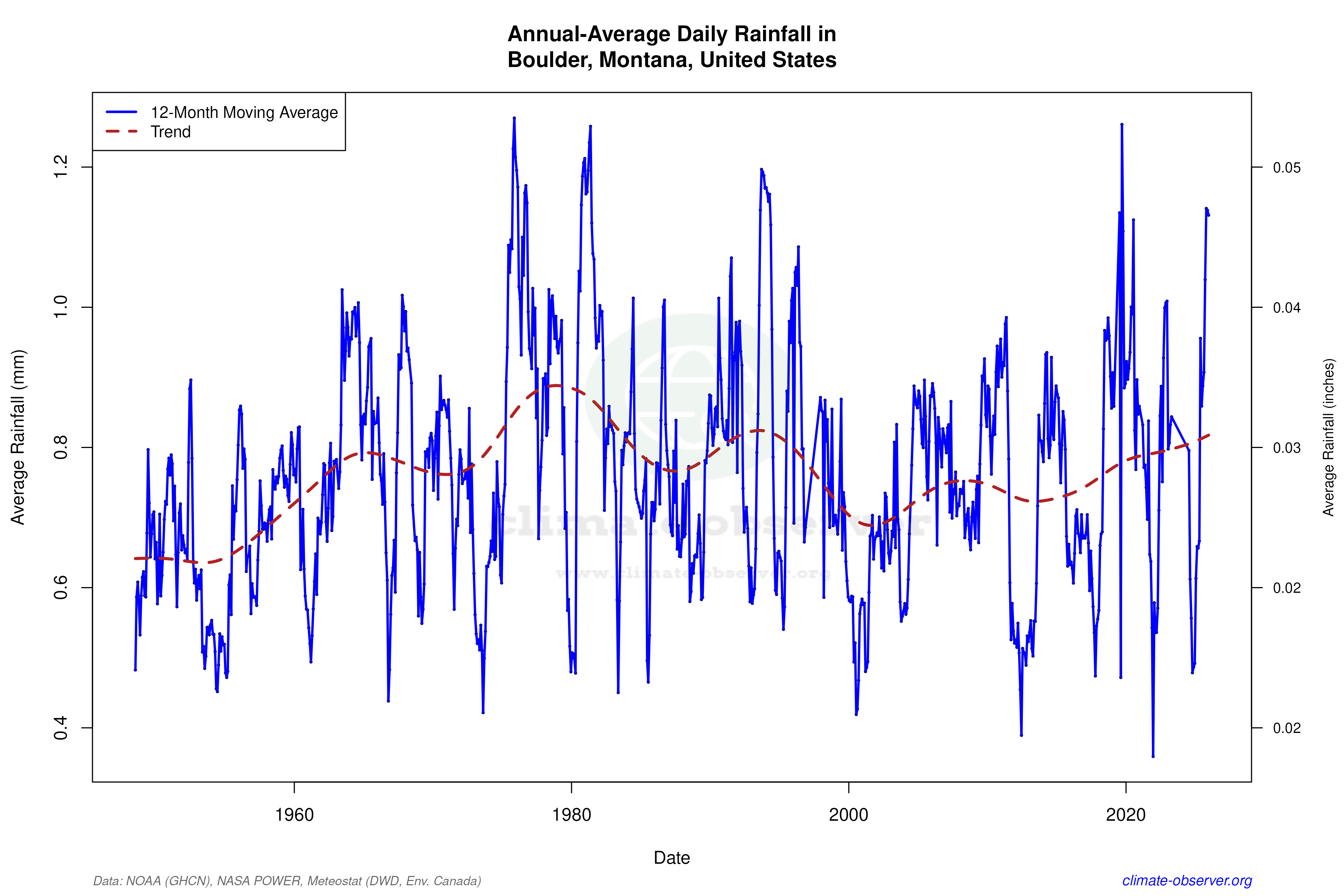
The Precipitation Concentration Index (PCI) provides insight into how rainfall is distributed throughout the year. Boulder's PCI has increased from a baseline of 18.27 to a current value of 24.67, indicating a significant shift towards more concentrated precipitation events. This means that rainfall is occurring in fewer, but more intense, episodes, which could lead to challenges such as increased runoff and potential flooding. This trend aligns with broader regional patterns in the United States, where climate goals are increasingly focused on managing water resources amid changing precipitation dynamics.
Record Extremes: A Climate of Contrasts
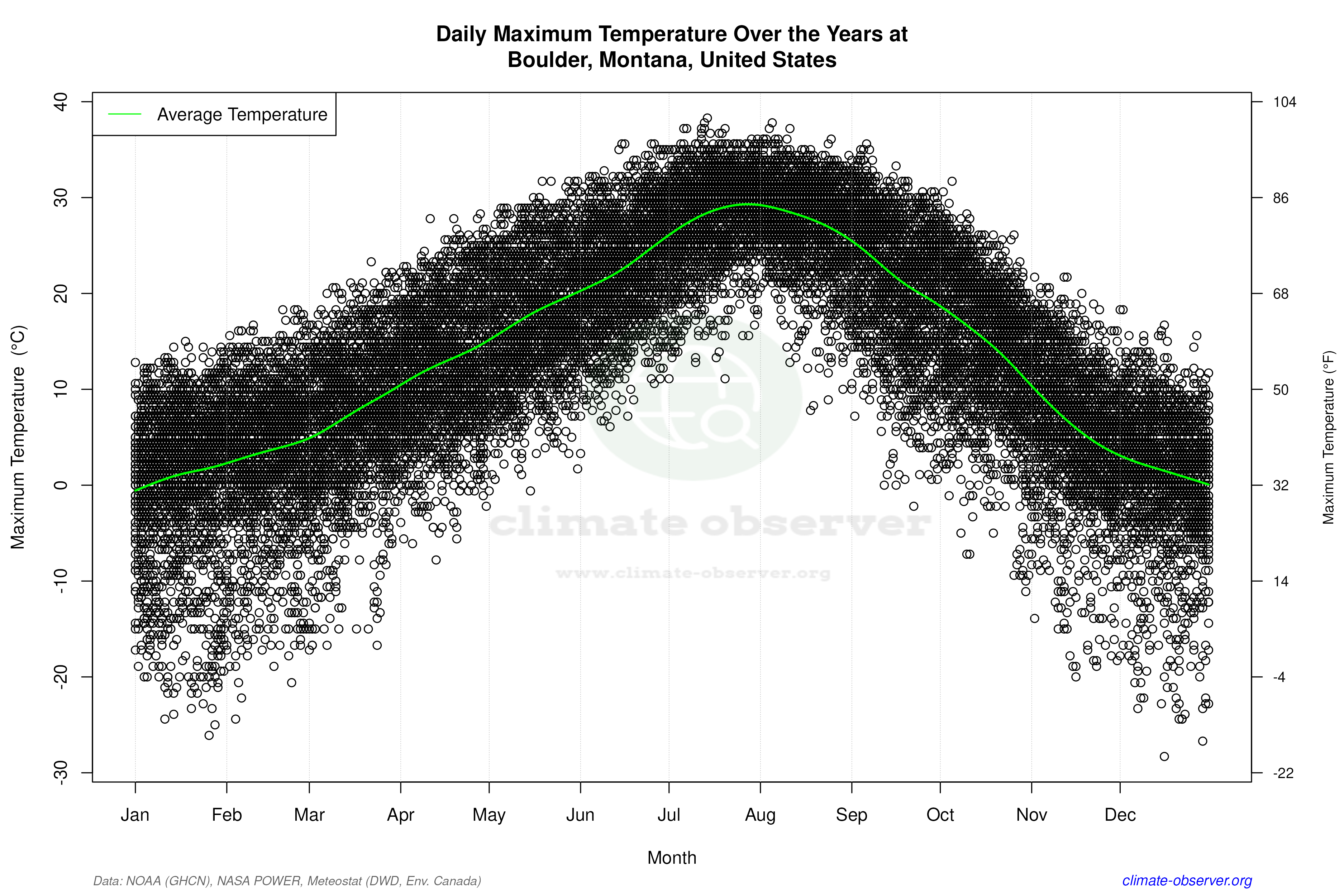
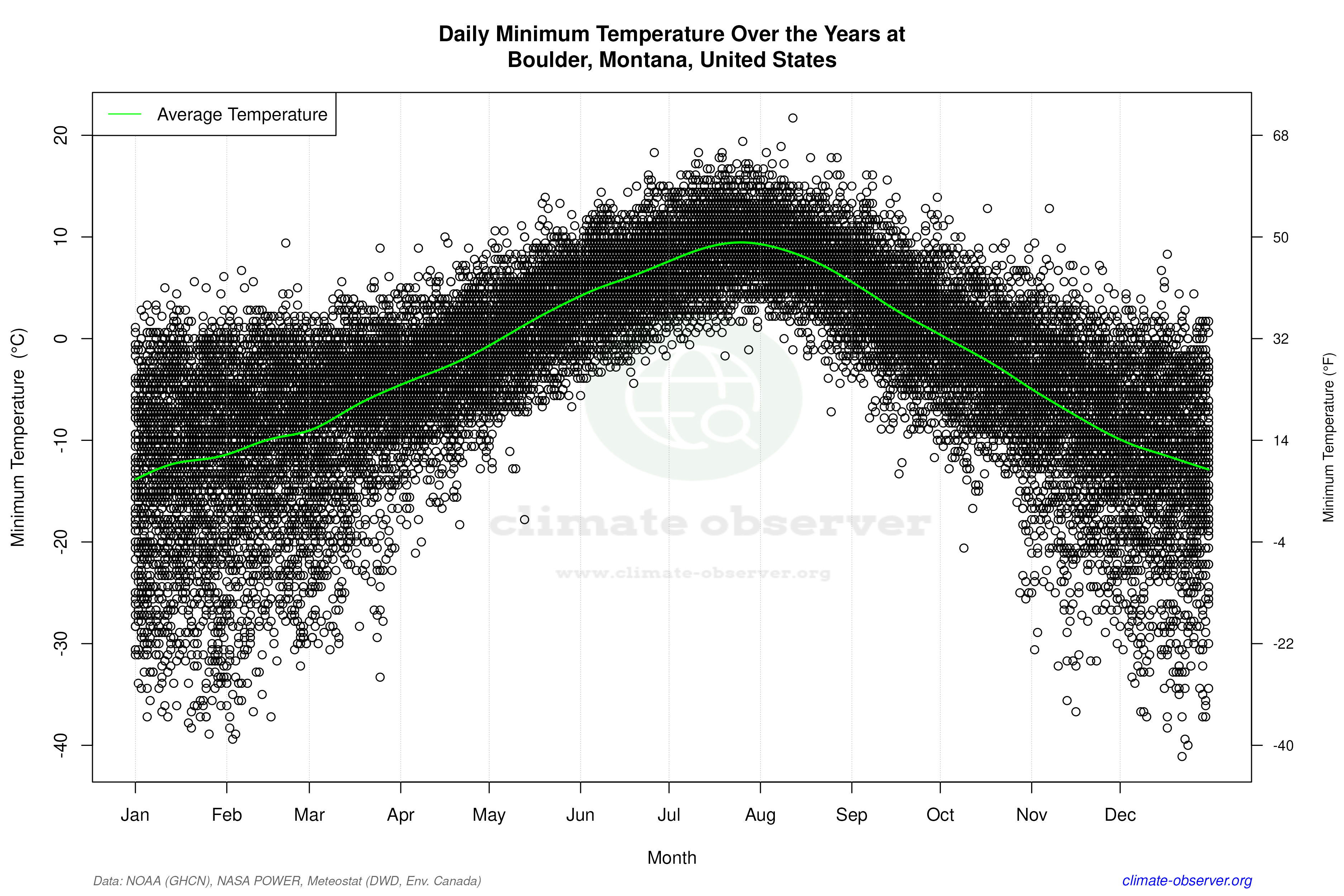
Boulder's temperature extremes highlight the region's climatic variability. The record high stands at 38.3°C (100.9°F), while the record low plunges to -41.1°C (-42.0°F). These figures underscore the dramatic temperature swings that can occur in this mountainous area, influenced by both elevation and continental positioning. Such extremes are not uncommon in the Rocky Mountain region and are a critical consideration for local climate adaptation strategies.
Implications for Regional Climate Goals
As Boulder navigates these climatic shifts, the data provides a crucial foundation for understanding and planning. The warming trends, particularly in high temperatures, and the increased concentration of precipitation events, are significant factors in shaping future climate resilience efforts. The region's climate goals will need to address these evolving patterns, focusing on sustainable water management and infrastructure adaptation to mitigate the impacts of these changes.
Station Statistics
10-Year Trend
High: +1.66 °C/decade
Low: -0.61 °C/decade
Rain: +0.10 mm/decade
25-Year Trend
High: +0.40 °C/decade
Low: -0.42 °C/decade
Rain: +0.03 mm/decade
50-Year Trend
High: +0.10 °C/decade
Low: +0.11 °C/decade
Rain: -0.02 mm/decade
All-Time Trend
High: +0.10 °C/decade
Low: +0.11 °C/decade
Rain: +0.01 mm/decade
Percentage Above-Average Days
Last 12 Months: 61.6%
This Year: 70.5%
Precipitation Concentration Index (PCI) ℹ️
Last 12 Months: 16.3
Historical Average: 16.5
Percentile Rank of Last 12 Months ℹ️
High: 80th percentile
Low: 32nd percentile
Rain: 97th percentile
Change in Variance ℹ️
High: +1.2%
Low: -0.7%
Intraday: +13.6%
Data Coverage
74.0%
First Year of Data
2026
Station Location
Historical Weather Records
| Max High | Avg High | Min High | Max Avg | Avg Avg | Min Avg | Max Low | Avg Low | Min Low | Max Precipitation | Avg Precipitation | Max Snow | Avg Snow | |
|---|---|---|---|---|---|---|---|---|---|---|---|---|---|
| Record | 38.3 °C | — | -28.3 °C | — | — | — | 21.7 °C | — | -41.1 °C | 47.0 mm | — | 305.0 mm | — |
| January | 15.0 °C | 0.9 °C | -26.1 °C | — | — | — | 6.1 °C | -12.4 °C | -38.9 °C | 35.6 mm | 0.4 mm | 254.0 mm | 5.8 mm |
| February | 18.3 °C | 3.6 °C | -24.4 °C | — | — | — | 9.4 °C | -10.0 °C | -39.4 °C | 15.2 mm | 0.3 mm | 203.0 mm | 4.1 mm |
| March | 23.3 °C | 7.5 °C | -17.2 °C | — | — | — | 8.9 °C | -6.8 °C | -33.3 °C | 13.2 mm | 0.4 mm | 292.0 mm | 4.1 mm |
| April | 28.3 °C | 12.7 °C | -7.8 °C | — | — | — | 10.0 °C | -2.9 °C | -21.1 °C | 34.8 mm | 0.6 mm | 305.0 mm | 2.8 mm |
| May | 31.7 °C | 17.9 °C | -0.6 °C | — | — | — | 13.9 °C | 1.8 °C | -17.8 °C | 43.2 mm | 1.4 mm | 102.0 mm | 0.3 mm |
| June | 35.6 °C | 22.8 °C | 3.3 °C | — | — | — | 18.3 °C | 5.9 °C | -5.6 °C | 38.9 mm | 1.7 mm | 102.0 mm | 0.1 mm |
| July | 38.3 °C | 28.4 °C | 11.1 °C | — | — | — | 19.4 °C | 8.9 °C | -1.7 °C | 47.0 mm | 1.1 mm | 0.0 mm | 0.0 mm |
| August | 37.8 °C | 27.8 °C | 7.8 °C | — | — | — | 21.7 °C | 7.9 °C | -7.2 °C | 39.4 mm | 1.0 mm | 0.0 mm | 0.0 mm |
| September | 35.6 °C | 22.0 °C | -2.2 °C | — | — | — | 16.1 °C | 3.0 °C | -13.3 °C | 30.0 mm | 0.9 mm | 76.0 mm | 0.1 mm |
| October | 31.7 °C | 15.0 °C | -11.1 °C | — | — | — | 12.8 °C | -2.1 °C | -25.6 °C | 30.5 mm | 0.5 mm | 279.0 mm | 1.0 mm |
| November | 21.7 °C | 6.2 °C | -20.0 °C | — | — | — | 12.8 °C | -7.5 °C | -36.7 °C | 26.7 mm | 0.4 mm | 305.0 mm | 3.0 mm |
| December | 18.3 °C | 1.6 °C | -28.3 °C | — | — | — | 8.3 °C | -11.4 °C | -41.1 °C | 15.7 mm | 0.3 mm | 216.0 mm | 4.1 mm |
Data Visualisations
Remove WatermarksCurrent Year Climate Trends vs Historical
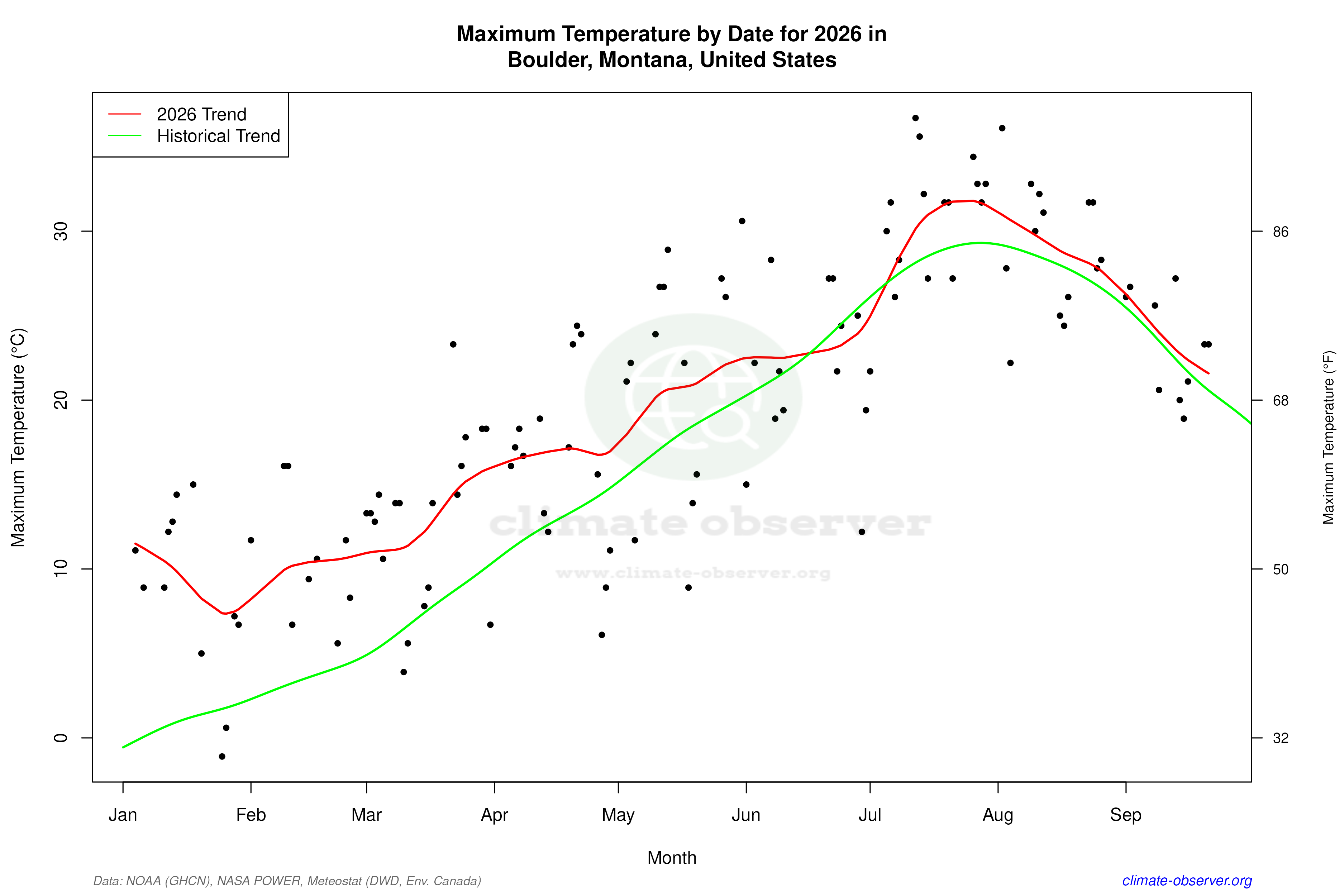
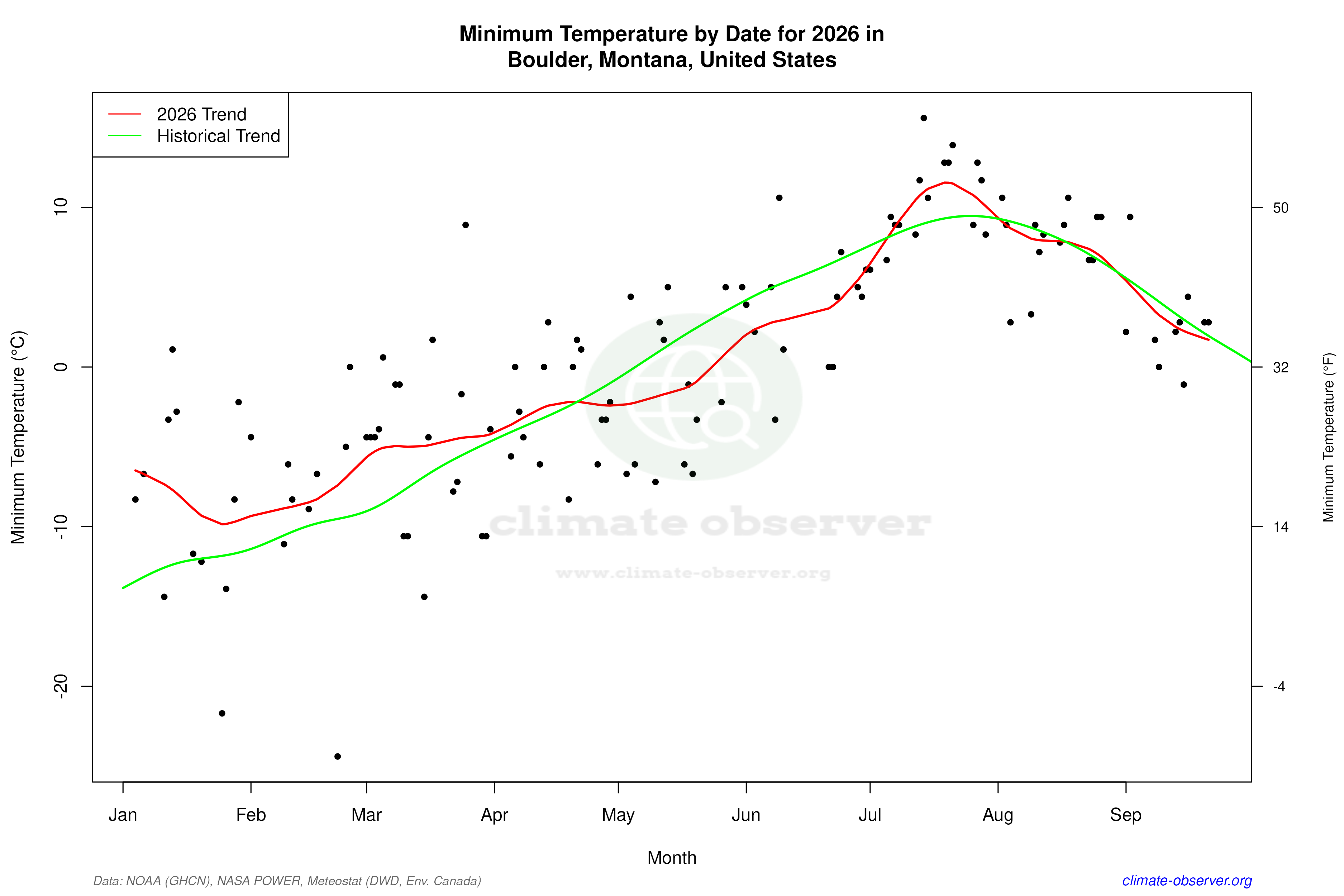

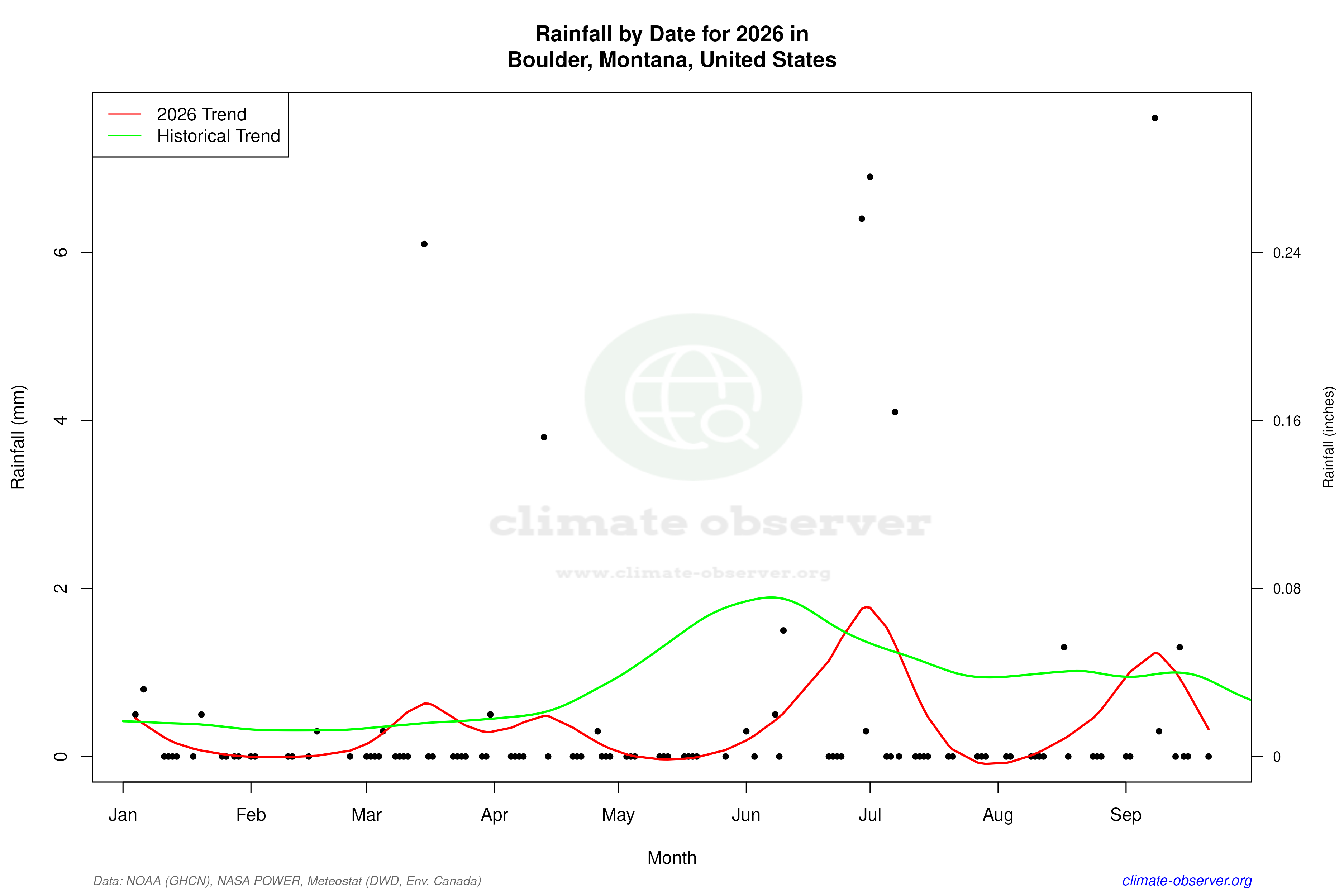


Max Temperature this Year | 1 of 6
Climate 12-Month Moving Averages
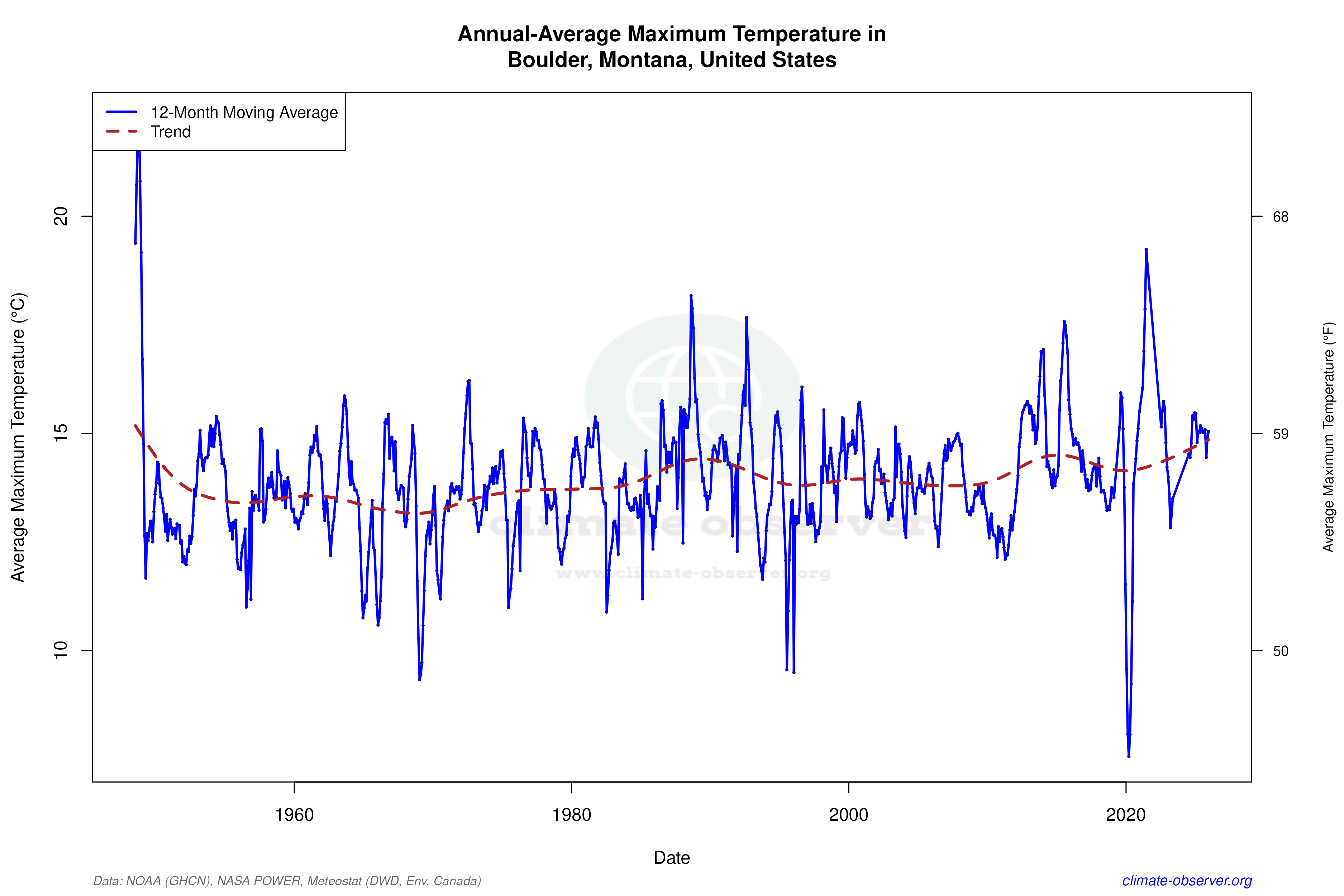



Max Temperature 12-Month MA | 1 of 6
Daily Data Points and Averages Throughout the Year


Average Max Temperature Throughout Year | 1 of 5


